
Online code editors and browser sandboxes let you write, preview, share, and sometimes run a project without setting up a local development environment. They are useful for reproducing a front-end bug, testing a small idea, teaching a concept, reviewing a pull request, or sending a client a live prototype.
The best choice depends on the size of the project and the kind of collaboration you need. A lightweight HTML, CSS, and JavaScript playground is usually faster for a minimal reproduction, while a browser IDE that can install packages is a better fit for a framework experiment.
Quick comparison
| Tool | Best fit | What to check before choosing |
|---|---|---|
| CodePen documentation | Small front-end demos, visual experiments, and embeddable Pens | Account and privacy settings, asset limits, and which editor features are available on the plan you use |
| JSFiddle | A quick HTML, CSS, and JavaScript fiddle with external resources | The selected framework version, resource URLs, and whether collaboration is appropriate for the code being shared |
| StackBlitz | JavaScript and framework projects that need a package-based workspace | Browser support, project startup time, and whether the project depends on server capabilities that cannot run in the browser |
| CodeSandbox | Shareable sandboxes for prototypes and larger front-end examples | Sandbox visibility, dependency versions, resource limits, and the difference between a browser sandbox and a cloud development environment |
| Replit | A shared browser workspace when the project needs more than front-end files | The selected language runtime, storage and hosting settings, account permissions, and plan limits |
1. CodePen for focused front-end demos
CodePen's documentation covers Pens, the editor, sharing, embeds, and the platform's available features. It is a good starting point when your example is primarily HTML, CSS, and JavaScript and you want a compact, easy-to-share result.
CodePen is particularly useful for:
- Building a visual CSS or interaction experiment.
- Making a small reproduction for a browser bug.
- Sharing a self-contained demo in a discussion or article.
- Exploring other developers' public examples before implementing an idea.
Keep a Pen focused. Put the smallest reproducible markup, styles, and script in it rather than copying an entire application. If the example needs private source code, API keys, customer data, or proprietary assets, use a private local or team environment instead.
2. JSFiddle for small HTML, CSS, and JavaScript tests
JSFiddle separates HTML, CSS, and JavaScript panels and provides documentation for its editor, frameworks, external resources, and sharing workflow. That makes it convenient for checking a small browser behavior or showing a reduced test case.
Use JSFiddle when you need to:
- Compare a few lines of HTML and CSS in a live preview.
- Test a JavaScript snippet with a selected library version.
- Share a reproducible example with someone reviewing a bug.
- Load a deliberately chosen external resource for a small experiment.
Record the framework and library versions in the description. A fiddle that depends on a moving CDN URL can stop reproducing the same result later, so pin versions where the service and library make that possible.
3. StackBlitz for package-based web projects
StackBlitz is designed for browser-based development environments rather than only isolated snippets. Its developer documentation explains the workspace model and the browser technologies behind its web development experience.
StackBlitz is a stronger fit than a small fiddle when you need:
- A project structure with multiple files.
- A framework starter or package manager workflow.
- A shareable reproduction that resembles a real application.
- A quick experiment with the JavaScript ecosystem.
There is an important boundary: code that works in a browser-based workspace is not automatically equivalent to code running on your production server. Check whether a dependency expects native modules, a long-running process, filesystem access, or another server capability before treating the sandbox as a production-like environment.
4. CodeSandbox for shareable application sandboxes
CodeSandbox provides browser-accessible sandboxes for building and sharing web projects. It is useful when a reproduction needs more files and dependencies than a small panel-based editor can comfortably provide.
CodeSandbox can be a practical choice for:
- Sharing a framework component with a teammate.
- Creating a reduced reproduction from a larger front-end project.
- Reviewing a proposed change without asking every reader to install the project first.
- Demonstrating a component with its supporting files and dependencies.
Before sharing, check the sandbox's visibility and remove secrets from environment variables, source files, and copied configuration. A public reproduction should contain only the smallest data and dependency set needed to explain the problem.
5. Replit for a broader browser workspace
Replit is a browser-based workspace that supports more than a front-end snippet. Its documentation is the right place to confirm the current language, collaboration, storage, and publishing capabilities for a particular project.
Choose a broader workspace such as Replit when the example needs a runtime or a small server as well as browser code. For a simple CSS issue, however, a smaller editor will usually be easier for another developer to open and understand.
Treat hosted workspaces as development environments, not automatic security boundaries. Review who can access the project, what the runtime can reach, how data is stored, and whether any publishing feature exposes the result publicly.
How to choose an online code editor
Use the smallest environment that proves the point
Start with a plain HTML, CSS, and JavaScript playground for a styling or DOM issue. Move to a package-based sandbox only when the issue depends on a framework, build step, module, or project structure. A smaller reproduction is faster to load and easier for someone else to debug.
Check browser and device constraints
Open the example in the browsers and devices that matter to your users. Browser sandboxes can use workers, WebAssembly, service workers, or other features that behave differently on mobile browsers or restricted networks. If a demo is part of documentation, provide a short explanation and a conventional code path rather than making the interactive editor the only way to understand it.
Make dependencies reproducible
Pin library versions where possible, keep external resources to a minimum, and write down the expected result. Do not assume that an unversioned CDN URL, a public project, or a hosted preview will remain unchanged forever.
Protect secrets and user data
Never paste production credentials, access tokens, private customer data, or unpublished source into a public editor. Browser tools are excellent for synthetic examples; they are not a reason to move sensitive debugging data into a third-party service. Redact identifiers and replace real responses with small fixtures.
Plan for the hand-off
A useful shared example has:
- A short statement of the expected and actual behavior.
- The smallest input that reproduces the problem.
- The browser or runtime versions that matter.
- Steps another person can follow to see the result.
- A note about any external dependency or intentional limitation.
For an accessibility issue, also include keyboard steps and the expected focus or announcement behavior. For a performance issue, state what is being measured instead of describing a demo as “faster” without evidence.
Preserving the original demo
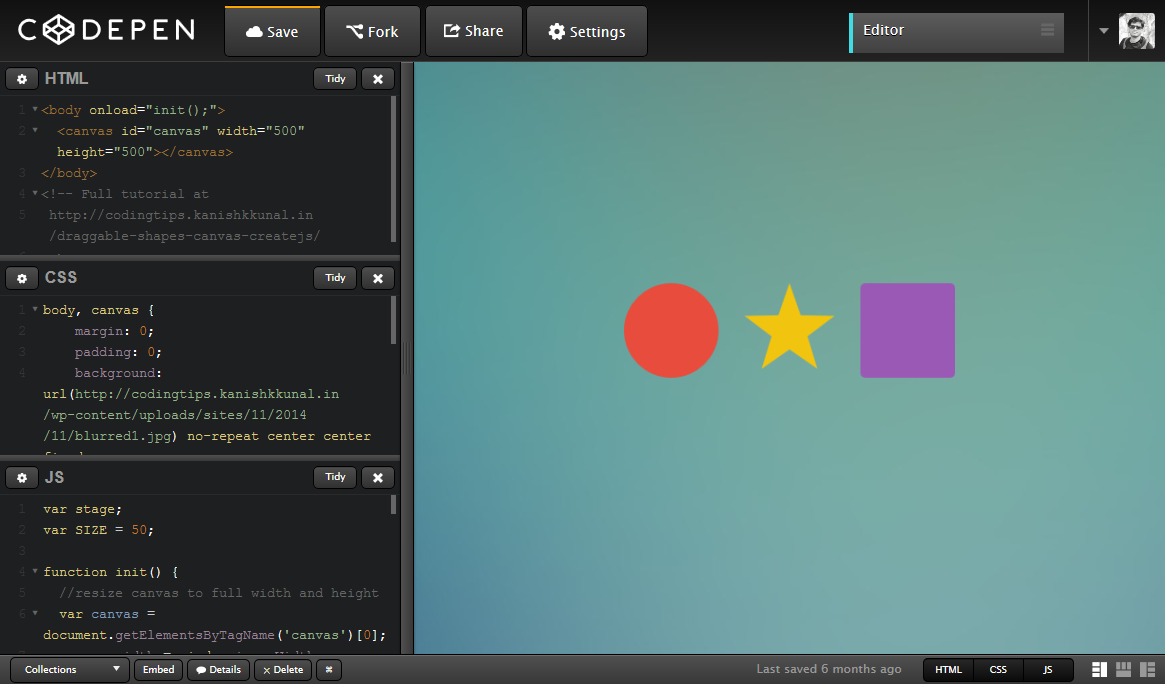
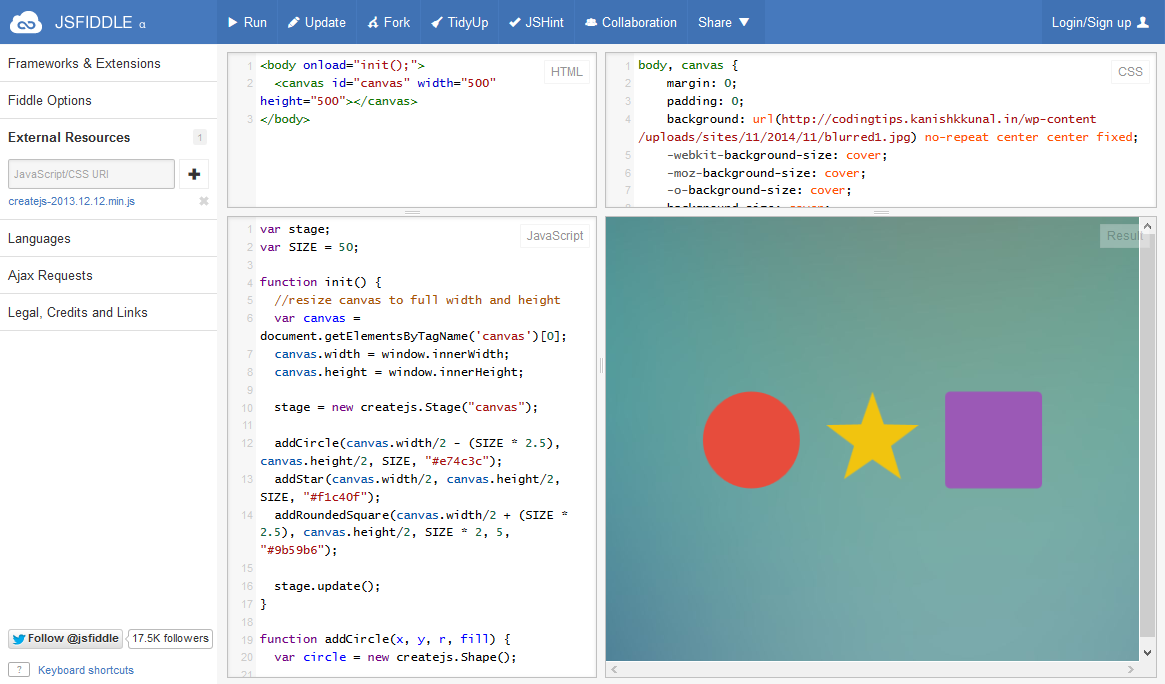
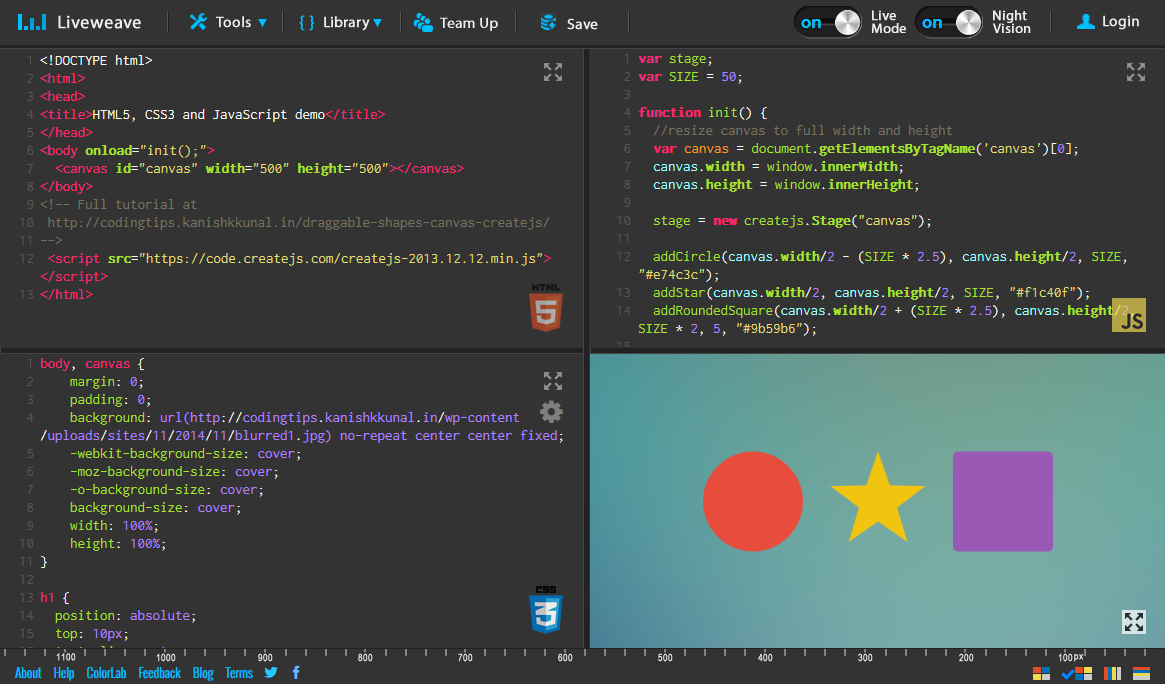
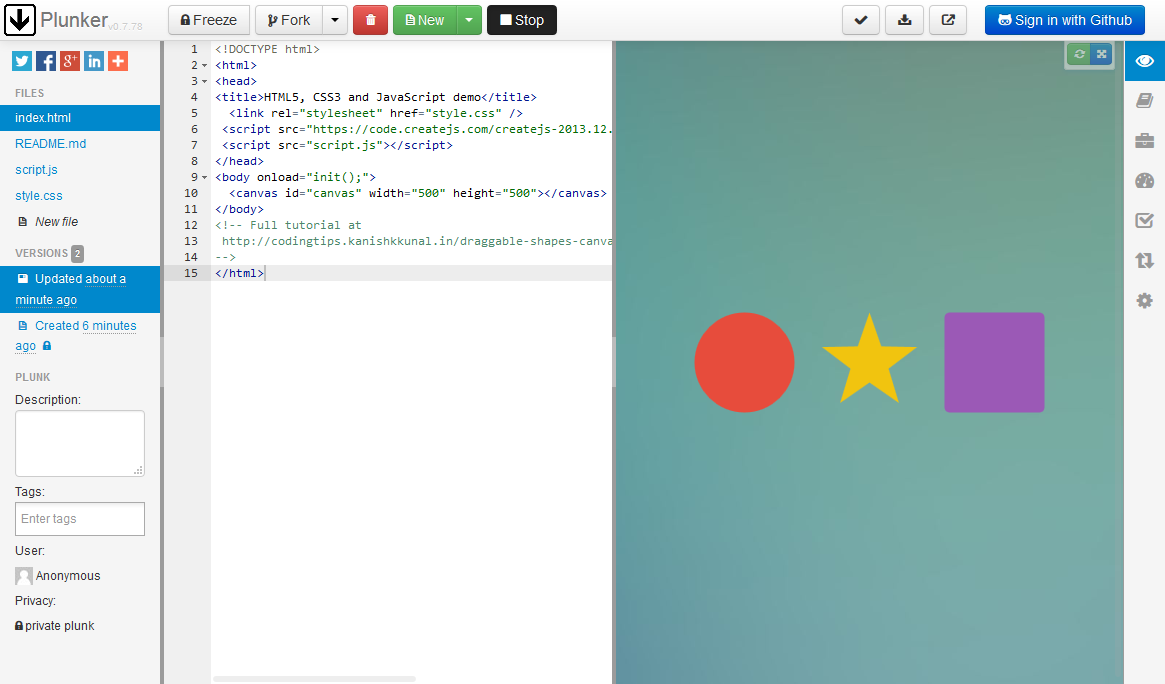
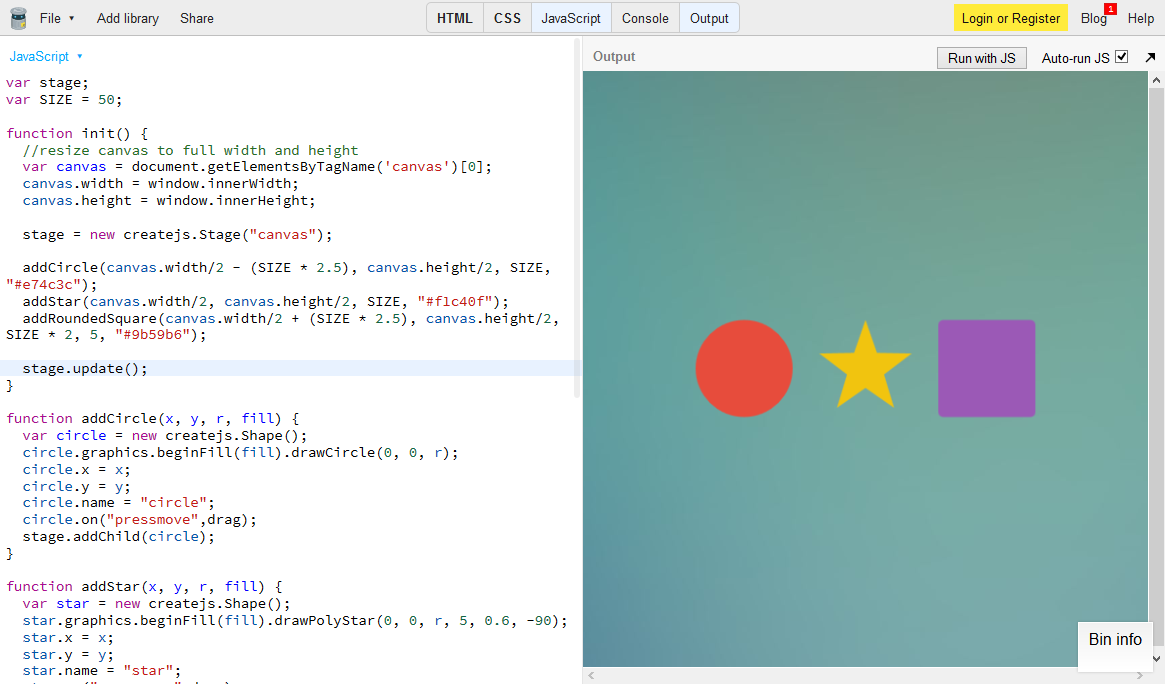
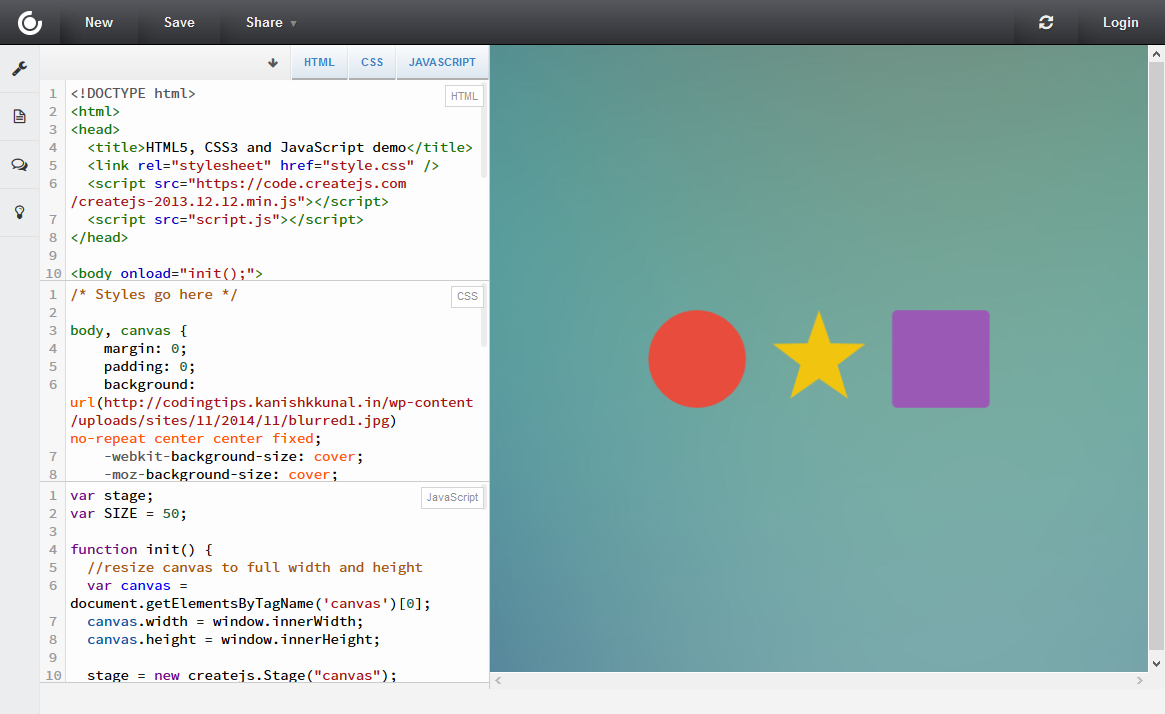
The original version of this article included a CodePen demo showing draggable shapes on a canvas. The draggable shapes with CreateJS demo remains a useful example of a self-contained front-end experiment. The older screenshots below are retained as historical media from that article; they should not be treated as current product documentation.
Archived screenshots from the original article
Final recommendation
For a quick front-end reproduction, start with CodePen or JSFiddle. Choose StackBlitz or CodeSandbox when the issue needs a real project structure and package dependencies. Use a broader workspace such as Replit when the example needs a runtime beyond the browser. In every case, share the smallest reproducible example, pin important dependencies, and keep secrets and private data out of the sandbox.

Wow. Thats a great list. Thanks!
You forgot about https://codepad.co/ :)
VSCode?
Bro VSCode is not an online code editor. You download it and then you can use it on your PC.
Can you add online javascript editor https://playcode.io/online-javascript-editor?
Another great cloud IDE is https://kodethon.com. Aside from being able to code with HTML, CSS, and Javascript, Kodethon allows you code in C, C++, Java, Python, Lisp and many other programming languages. It is similar to Cloud9 but with an emphasis on ease-of-use.
Here are some demos: https://www.kodethon.com/#/CDE?c=3ea01b0aa8663331cfc6913889430de4
Web based code editors are able to find use in multiple scenarios. Whether you require to jot together a quick-prototype of your projects, or you want to share a demo with your client, or even when you want to collaborate with others in your team, these online tools would make a good choice to keep in your bookmark.