
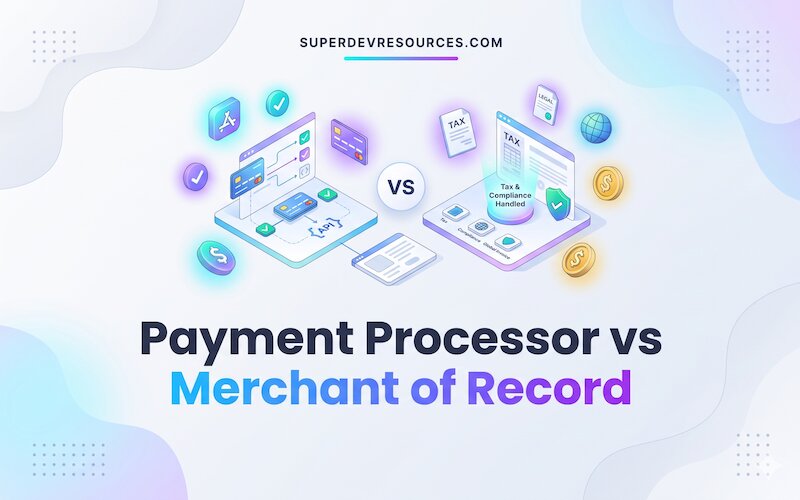
When you sell software directly to customers, choosing a checkout provider also determines who handles taxes, refunds, disputes, and subscriptions. A payment processor can give you more control, but you remain responsible for running those parts of the business. A merchant of record (MoR) takes on more of the transaction work in exchange for a larger per-sale fee and a checkout relationship you need to understand.
The right fit depends on where your customers are, how much operational work you can take on, and whether the provider supports your product and business location. This guide compares direct processing with current options from Stripe, Paddle, and Lemon Squeezy. It is not tax or legal advice; confirm your obligations with a qualified adviser in your jurisdiction.
Payment processor vs merchant of record
With a direct payment processor, your business is the seller. The processor authorizes and routes payments, but you generally manage the customer-facing sale: tax registrations and filings, refund policies, dispute responses, and support. Tax or billing software can help with parts of this work, but it does not automatically make the provider your seller.
With a merchant of record, the provider is the legal seller for the customer's purchase. Depending on the provider and agreement, it can collect and remit indirect taxes such as VAT, GST, and sales tax, and handle payment processing, refunds, disputes, and buyer support. You still sell and support your software under the supplier agreement.
An MoR does not take care of every obligation your business has. You remain responsible for matters such as income tax on payouts, accounting, product rights, privacy, delivering the software, and the terms of your relationship with the provider. Read the supplier agreement to see which costs or liabilities can still be passed back to you.
Compare the main options
| Option | Current pricing and services | Often suits |
|---|---|---|
| Direct Stripe Payments | Processing rates depend on your business country and payment method. Stripe Billing and Stripe Tax are separate products. Your business remains the seller. | Builders who want more checkout flexibility and can manage tax, refunds, and support themselves or with other services. |
| Stripe Managed Payments | Adds 3.5% per successful transaction to standard Stripe processing. Stripe becomes the MoR for supported transactions and handles indirect tax, fraud, dispute responses, and transaction-level support. | Eligible digital-product businesses already using Stripe that want to offload those tasks, possibly only for selected markets or products. |
| Paddle | Standard pay-as-you-go pricing is 5% + $0.50 per checkout transaction, with checkout, subscriptions, tax compliance, fraud protection, chargebacks, and buyer support included. Custom pricing is available for some businesses. | Software sellers who prefer one provider for checkout, recurring billing, and global tax operations. |
| Lemon Squeezy | Base fee is 5% + $0.50 per order, with additional fees for some international, PayPal, and subscription payments. It includes tax handling and software-focused features such as license keys. | Digital-product sellers who want a managed checkout and built-in software sales tools. |
These are headline structures, not an apples-to-apples net-payout estimate. Fees can depend on transaction size, customer location, payment method, currency conversion, tax, and optional products. Recheck the linked pricing pages before you choose.
Direct processing with Stripe
Stripe's standard payments product processes a payment without making Stripe the merchant of record. Your business remains responsible for the sale. Stripe Tax can calculate tax, monitor possible obligations, and support registration and filing workflows, but using it does not change who is the seller.
Stripe also offers a separate MoR product, Managed Payments. Its current pricing adds 3.5% per successful transaction on top of standard processing fees; optional products such as Billing are separate. It supports selected digital products and business locations, and its documentation excludes Connect platform accounts. Eligibility is not universal: as of November 14, 2026, India's business location was not on Stripe's published Managed Payments eligibility list. Check the current list and product restrictions before planning around it.
Managed Payments can be used selectively for eligible transactions, which may help when you want to test new markets without moving every sale. Compare the extra percentage with the indirect-tax and dispute work you would otherwise handle.
Paddle
Paddle's pricing page lists a 5% + $0.50 fee per checkout transaction, with no monthly or migration fee on its standard pay-as-you-go offer. The service includes subscriptions, buyer support, and fraud and chargeback handling. Paddle says its MoR service registers, collects, files, and remits sales tax in more than 100 jurisdictions through its tax and compliance service.
That bundled approach can be useful when you want fewer separate billing and tax systems. Check your expected average order value: Paddle says sellers of products under $10 can contact it about custom pricing. Also review its current supplier terms, supported countries, payout schedule, refund rules, and data-export options before moving an existing subscription business.
Lemon Squeezy
Lemon Squeezy's pricing lists a base fee of 5% + $0.50 per transaction. Its fee documentation adds 1.5% for transactions outside the US, 1.5% for PayPal, and 0.5% for subscription payments. The platform fee is calculated on the total order value, so tax added at checkout can affect the fee too.
Lemon Squeezy describes itself as the merchant of record and provides software-oriented tools such as subscription management and license-key delivery. Its current payout documentation says payouts are created twice monthly, sales are held for 13 days before payout, and a $50 minimum applies. That timing can matter if you depend on fast cash flow; payout fees can also vary by region and method.
What stays your responsibility?
| Area | Direct processor | Merchant of record |
|---|---|---|
| Indirect sales tax on the order | You determine where you must register, collect, file, and remit. Tax software can assist. | The provider handles the covered transaction taxes in its supported jurisdictions; confirm product, country, and contract coverage. |
| Refunds and disputes | You make and carry out refund decisions and typically submit dispute evidence. | The provider generally handles the buyer-side payment process, but check whether refunds, reserves, or losses can be charged back to you. |
| Software and customer relationship | You own the checkout and customer workflow, subject to your provider's terms. | The provider may control parts of checkout, receipts, and buyer support. Verify which customer and subscription data you can export or migrate. |
| Business obligations | You handle your product, policies, accounting, and tax obligations. | Those obligations do not disappear just because the provider is the MoR. |
For subscription products, also compare cancellation handling, failed-payment recovery, plan changes, invoices, and migration. A payment provider's recurring-billing features may be a separate paid product; a bundled plan may still have limits or require you to follow its checkout flow. If you are still deciding whether a recurring software product fits your business, see our guide to the SaaS business model.
How to choose
Choose direct processing when you need control over the checkout and billing flow, your sales are concentrated in markets you understand, or you already have a reliable way to manage indirect taxes, refunds, and support. For example, Stripe's standard processing can be a better fit if you are comfortable pairing it with your own billing and compliance workflow.
Choose an MoR when global consumer sales would otherwise require you to build and maintain tax and payment operations across multiple markets. Its higher transaction fee can be worth paying if it replaces work, services, and compliance risk that you would otherwise own. Compare the total cost, not just the percentage: include fixed transaction fees, tax on the order, currency conversion, subscription add-ons, payout costs, and the time needed to reconcile sales.
Before switching, check:
- Eligibility: Does the provider accept your business location, software category, target customers, and pricing model?
- The complete fee: What is charged on the order total, and what extra charges apply for international cards, subscriptions, currency conversion, refunds, and payouts?
- Taxes and records: Which indirect taxes does the provider file and remit, and what reports or invoices will you need for your own accounting and income-tax work?
- Refunds and disputes: Who responds to the buyer, who supplies evidence, and who ultimately bears a refund, chargeback, or reserve?
- Subscriptions and portability: Can customers self-manage subscriptions? Can you export customer, payment, and subscription records or migrate recurring billing if you leave?
- Cash flow: How often are payouts made, what minimums or holds apply, and in which currency will you receive funds?
If you are unsure, start with a small, well-defined product or market only if your provider and existing terms allow it. Keep the seller shown at checkout, tax responsibility, refund path, and customer records clear while you compare real costs. An MoR is a way to outsource specific transaction responsibilities—not a substitute for understanding the rest of your business obligations.
